
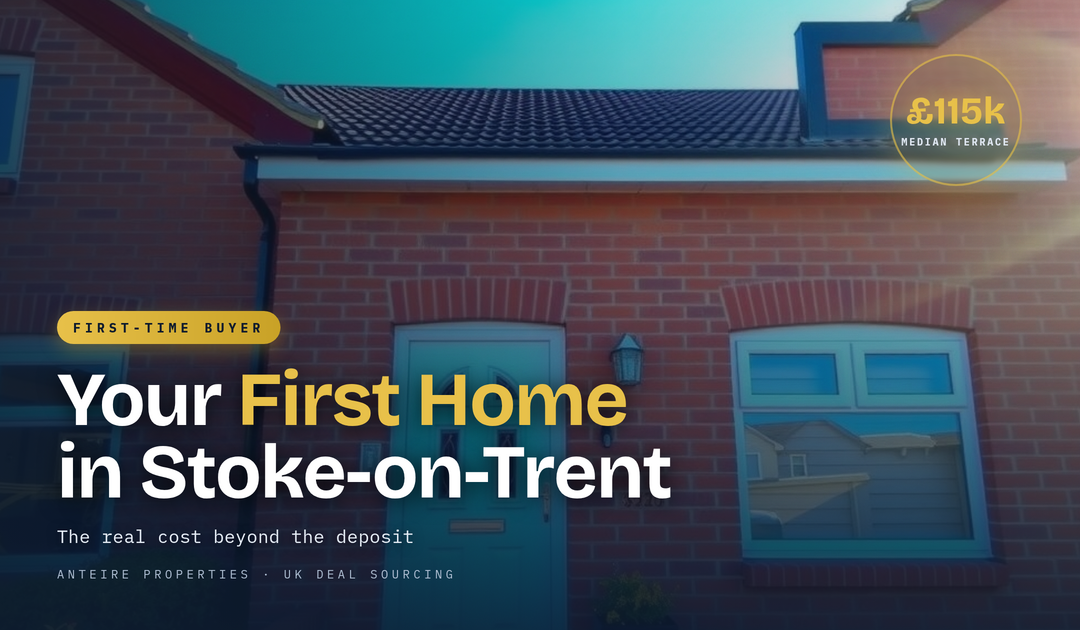
Everyone shopping for a first home in Stoke-on-Trent fixates on the asking price. It is the wrong number to anchor on. The price on the portal tells you what the seller hopes for; it says nothing about what the house actually costs you to own, and nothing about whether a mortgage lender will put you there at all. This guide starts with what homes in Stoke-on-Trent have actually sold for in recent months — then adds up the real cost of getting the keys.
The table below is not a market estimate. It is a straight median of the 2,400 most recent completed sales the Land Registry recorded in Stoke-on-Trent, from late February to late September 2026, split by property type and computed for this article.
Stoke-On-Trent sold prices: computed for this article
| Property type | Sales | Median sold price |
|---|---|---|
| Semi-Detached | 954 | £180,000 |
| Terraced | 778 | £115,000 |
| Detached | 486 | £293,500 |
| Other | 91 | £157,000 |
| Flat-Maisonette | 91 | £86,625 |
| All types | 2400 | £168,250 |
Method: computed from HM Land Registry Price Paid data, retrieved 2026-11-03: 2400 completed sales in Stoke-On-Trent between 2026-02-19 and 2026-09-28. Middle half of the market: £116,000–£233,000. Land Registry records completed sales only, so this dataset cannot support any rent, yield, growth or asking-price figure. Do not state one.
Read that table the way a lender does. In Stoke-on-Trent the median terraced house sold for £115,000 and the median semi for £180,000, while the typical sale across all types sat at a median of £168,250. The middle half of the whole market fell between £116,000 and £233,000. For a first-time buyer, the headline is simple: the terrace is the entry point, and in Stoke-on-Trent that entry point is genuinely low by English standards. Nearly 800 of those sales were terraces, so this is a deep, liquid part of the market — not a handful of outliers.
The deposit is the smallest number on the page
Most first-time buyers save for a deposit, hit the target, and assume they are ready. They are not. Completing a purchase triggers a cluster of one-off costs that nobody puts on a flyer, plus a monthly payment that is the real test of affordability. The worked example below shows every line, start to finish, on the median Stoke terrace. The figures are assumptions chosen to show the method — your own quotes will differ — not a quote and not a specific property.
| Line | Illustrative amount | Note |
|---|---|---|
| Purchase price (median terrace) | £115,000 | the figure we are building on |
| Deposit at 10% | £11,500 | 10% of £115,000; 5% would be £5,750 |
| Mortgage (90% loan) | £103,500 | the rest of the price |
| Stamp Duty (SDLT) | £0 | England first-time-buyer relief: nothing to pay below £300,000 |
| Conveyancing / legal | £1,200 | solicitor + searches; typically £900–£1,500 |
| Homebuyer survey (Level 2) | £500 | skip this and you inherit the roof you did not inspect |
| Mortgage + valuation fees | £500 | lender arrangement and valuation |
| Removals | £400 | van, or a mate with a van and a crate of beer |
| Cash to complete | £14,100 | deposit + £2,600 of fees |
| Monthly mortgage payment | £556 | £103,500 at an illustrative 5.0% over 30 years |
Two things jump out. First, the fees beyond the deposit add roughly another fifth on top of a 10% deposit — budget for them or your completion date slips. Second, the monthly payment on a Stoke terrace is comfortably below what the same household would pay to rent an equivalent home in much of the country, which is exactly why getting onto the ladder here matters more than the sticker shock suggests. The barrier is almost never the monthly cost. It is the cash to complete and the lender’s willingness to lend.
Buy, rent, or rent-to-own? Reading the averages
Sold prices tell you what buyers paid. To weigh buying against renting you need the rental side too — and here it pays to be precise about what each number measures.
Area averages: computed for this article
| Area | Average price (Aug 2026) | Average rent pcm (Sep 2026) | Gross yield |
|---|---|---|---|
| Stoke-on-Trent | £150,112 | £718 | 5.7% |
retrieved 2026-10-24. Price data: HM Land Registry UK House Price Index (average, Aug 2026). Rent data: ONS Price Index of Private Rents (average, Sep 2026). Contains HM Land Registry data © Crown copyright and database right 2026. This data is licensed under the Open Government Licence v3.0. Source: Office for National Statistics licensed under the Open Government Licence v3.0. Yields are gross area averages, not valuations or forecasts.
Further reading from the same official sources: ONS Price Index of Private Rents and House Prices and the HM Land Registry UK House Price Index.
Notice the two headline prices disagree: the average price for Stoke-on-Trent above is £150,112, while the median sale in the first table was £168,250. That is not an error — they measure different things. The £150,112 is a mix-adjusted index average that smooths the blend of property types and strips out one-off extremes; the £168,250 is a raw median of the actual homes in this sample of completed sales. The two also cover different periods and are built on different methods, so a gap between them is expected, not a mistake. When you see “average” and “median” quoted for the same town, always check which is which before you compare them. For Stoke-on-Trent the ONS puts the average rent at £718 a month against that £150,112 average price, a 5.7% gross yield — and West Midlands rents rose 4.4% over the year to September 2026. Rents climbing faster than many wages is the quiet reason a deposit target keeps moving away from renters.
If the deposit or the mortgage is the blocker
For a lot of Stoke households the monthly payment is affordable but two doors stay shut: they cannot assemble the cash to complete, or a thin credit file and self-employed income make a high-street lender nervous. That gap — affordable in principle, blocked in practice — is exactly where a rent-to-own or assisted-purchase route earns its place. You move into the home now on a tenancy with a fixed option to buy at an agreed price within an agreed window, and part of what you pay each month builds toward the purchase while you repair credit or finish saving. It is not magic and it is not for everyone, but for the right buyer it converts “not yet” into “in eighteen months”.
Five checks before you sign any assisted-purchase deal
- The option price is fixed in writing. You should know today the exact price you will pay to buy, and the exact date range the option covers. “We’ll agree it later” is not a deal.
- You know who owns the house. Ask for the title and confirm the person offering the option is the legal owner or has the owner’s written authority. Verify it, do not take it on trust.
- The monthly figure, and what counts toward the purchase. Get the rent, any option premium, and the exact amount credited toward your eventual purchase in one written schedule.
- A clear, independent legal review. Your own solicitor reads the agreement before you sign — not the seller’s, not the packager’s.
- An honest exit. Understand what happens, and what you get back, if your circumstances change and you cannot complete. A fair deal spells this out up front.
A well-packaged deal answers all five before you ask. If any answer is vague, that is your signal to slow down — a good opportunity survives scrutiny.
Sources
- Sold prices: HM Land Registry Price Paid data (completed sales, retrieved 2026-11-03).
- Average price: HM Land Registry UK House Price Index.
- Average rents and rent inflation: ONS Price Index of Private Rents and House Prices.
Work With Anteire Properties
If buying in Stoke-on-Trent is affordable month-to-month but the deposit or a lender is holding you back, talk to us about an assisted-purchase route — we’ll tell you honestly whether it fits before you commit a penny.
📞 Call assistance (24/7): +44 7898 115789
💬 WhatsApp: message us on WhatsApp
🔗 Opportunities for buyers and investors