
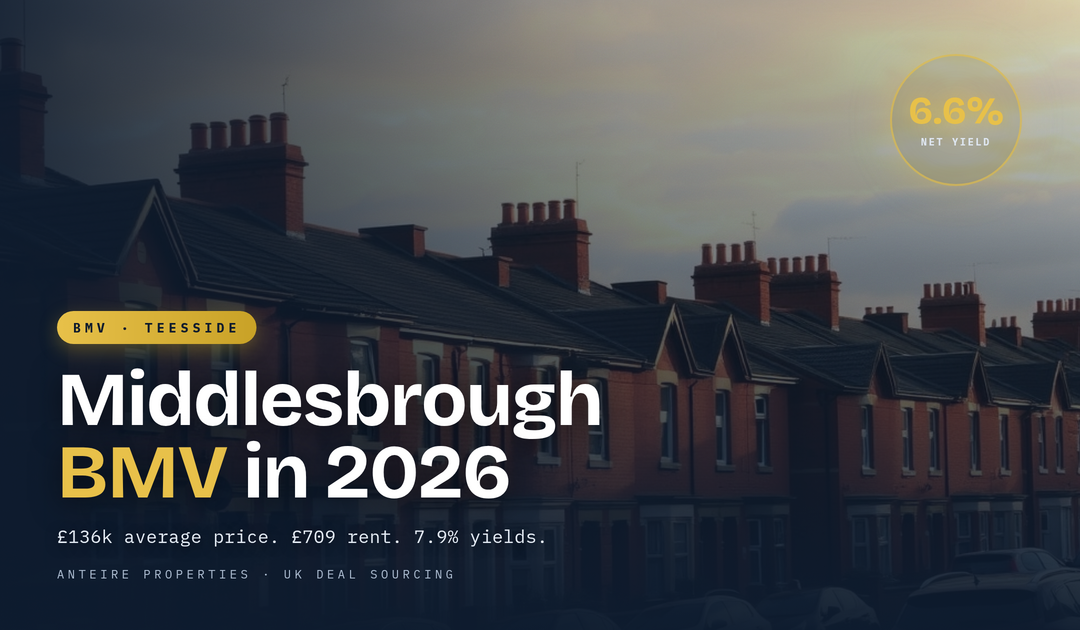
An average house price of £136,000 and an average rent of £709 a month (ONS, Housing prices in Middlesbrough — price February 2026, rent March 2026). Do that division and you land on a gross yield north of 6% before you have negotiated a single pound off the asking price — and Middlesbrough's town-wide average yield is running closer to 7.9%, with TS3 stock hitting 8.3%.
Now put £2 billion of investment secured from occupiers at Teesworks next to it, a town-centre university campus, and a £200m regeneration scheme in the middle of Middlesbrough itself. That is not a "cheap house" story. That is a market where the income works today and the exit gets better over the next five years.
Middlesbrough sold prices — computed for this article
| Property type | Sales | Median sold price |
|---|---|---|
| Semi-Detached | 793 | £155,000 |
| Terraced | 671 | £85,000 |
| Detached | 343 | £270,000 |
| Flat-Maisonette | 85 | £78,500 |
| Other | 56 | £133,499 |
| All types | 1948 | £140,000 |
Method: computed from HM Land Registry Price Paid data,
retrieved 2026-07-25 — 1948 completed sales in Middlesbrough between
2025-07-25 and 2026-05-27. Middle half of the market: £86,000–£207,500.
Land Registry records completed sales only, so this dataset cannot support any
rent, yield, growth or asking-price figure — do not state one.
Private rents in the North East rose
6.3% over the year to June 2026, against
3.4% for England as a whole. Source:
ONS Price Index of Private Rents, retrieved 2026-07-25.
This is the rate of CHANGE by region — ONS regional data does not give a £/month
rent for this town, so do not state one.
Here is how we look at Teesside BMV in 2026 — the numbers, the postcodes, the seller types, and the three ways investors get it wrong.
The numbers that make Teesside work
Middlesbrough's average house price was £136,000 in February 2026 — broadly flat on February 2025, according to ONS local housing price data. Flat is not a problem when you are buying for income; flat plus a discount is an opportunity.
Rents have not been flat. Private rents in the area averaged £709 in March 2026, up 8.4% from £655 a year earlier. That is the shape you want: purchase prices holding, rents climbing. Every month that continues, the yield on money already invested goes up without you doing anything.
For context, the North East as a region averages roughly £114,000 on price against £748 monthly rent. Middlesbrough and Sunderland are the two towns that consistently print 8%+ gross for investors who buy properly.
- Average price: £136,000 (Feb 2026, ONS)
- Average rent: £709 pcm (Mar 2026, +8.4% YoY)
- Town-wide gross yield: ~7.9%
- Best postcode yields: up to 8.3% (TS3, North Ormesby)
What "below market value" actually means here
BMV is not a discount off an asking price. Asking prices in TS postcodes are frequently optimistic by 8–12% already. A "15% BMV" deal priced off an inflated ask can be full market value with a nicer headline.
Real BMV is a discount off comparable sold prices — Land Registry completions on the same street, same property type, within the last six months. That is the only number we underwrite against, and it is the number that decides whether a deal goes into our pack or into the bin.
A worked example on a typical Middlesbrough two-bed terrace:
- Comparable sold value: £92,000
- Purchase price agreed: £74,000 (19.5% below comparables)
- Light refurb — kitchen, bathroom, decorate, EPC works: £11,000
- All-in before fees: £85,000
- Achievable rent: £675 pcm = £8,100 a year
- Gross yield on all-in cost: 9.5%
Net, after 12% management, insurance, a 5% void allowance and a £600 annual maintenance float, that lands around 6.6% net — before finance. That is the number worth chasing in 2026, and it is very hard to find in the South at any price. Illustrative figures based on a representative Teesside terrace, not a quote on a specific property. Not financial advice.
Why the discount exists in the first place
Discounts are not charity. They are paid for by a seller who values speed and certainty more than the last £8,000. In Teesside, four seller types produce most of the genuine BMV stock:
- Tired landlords. Post-Renters' Rights Act compliance, EPC band C obligations and higher refinance costs have pushed a wave of one-to-three-property landlords toward the exit. They want out cleanly, often with tenants in situ — which is a gift if the tenants are good.
- Probate and inherited stock. Beneficiaries living 200 miles away rarely want a nine-month refurb project. They want a completion date.
- Refinance squeeze. Owners who fixed in 2021 and rolled onto 2026 rates and cannot make the numbers work.
- Chain breaks. Someone has committed to a purchase and needs to complete in weeks, not months.
Notice what unites them: none of them is motivated by price alone. They are motivated by certainty. Which means your leverage as a buyer is proof of funds and a realistic timeline — not a lowball offer with no evidence behind it.
The postcodes, honestly
TS1 — town centre, university-adjacent. Strongest student and young-professional demand, and where the £200m regeneration and the 400-bed student scheme are landing. Highest tenant churn; best capital-growth case.
TS3 — the headline yield postcode at up to 8.3%. Cheapest entry, highest gross. Also the postcode where tenant selection and management quality decide whether you actually collect that 8.3% or just quote it. Do not buy TS3 with a hands-off management arrangement and a cheap letting agent.
TS4 / TS5 — the middle ground. Slightly higher entry, noticeably steadier tenancies, better resale liquidity. For a first Teesside purchase, this is usually where we point people.
TS6 and out toward Redcar — closest to the Teesworks employment story. Longer-term play; the jobs are arriving faster than the housing stock is being upgraded.
The three ways investors get Teesside wrong
1. Buying the yield spreadsheet, not the street. A 9% gross on a street with three boarded windows is a 4% net after voids and arrears. Yield is a forecast; the street is a fact. Look at both.
2. Under-budgeting the EPC. A lot of pre-1930 Teesside terraced stock sits at band D or E. Getting to band C on solid-wall properties is not a £1,500 job. Price it before you offer, not after you exchange.
3. Trusting the sourcer's valuation. If a deal pack quotes the asking price as the "market value," the discount is fiction. Ask for the Land Registry comparables. Any sourcer worth working with will send them without being chased — we put them in the pack as standard, because a deal that only works on optimistic figures is not a deal.
How to underwrite a Teesside deal in ten minutes
- Pull the last six months of Land Registry sold prices for the street and the two streets either side. That is your value, not the ask.
- Check three comparable rentals currently let, not currently listed. Listed rents are asks; let rents are facts.
- Get the EPC from the register and price the gap to band C.
- Run net, not gross: deduct management, insurance, a 5% void allowance and a maintenance float.
- Stress-test at a 2% rate rise and one month of voids. If it still clears, it is a deal.
If it fails any of those, walk. In a market with £136,000 average prices and this much stock turnover, there is always another one next month.
Where this sits in a portfolio
Teesside is not a capital-growth market and pretending otherwise is how people get hurt. It is an income market with a genuine regeneration tailwind — which is a rarer and more useful thing. Buy it for the 6–7% net, treat any capital appreciation from the Teesworks and town-centre schemes as upside rather than as the plan, and the numbers hold up under stress.
The investors doing best out of Teesside right now are the ones buying two or three properties in one postcode with one management relationship, rather than one property each in five towns. Density beats diversification when the ticket size is this small.
Work With Anteire Properties
We source, underwrite and package below-market-value deals across the North East and the Midlands — with Land Registry comparables in every pack, so you are underwriting facts rather than someone's asking price. If Teesside income at 6%+ net fits your strategy, let's talk.
📞 Call assistance (24/7): +44 7898 115789
💬 WhatsApp: message us on WhatsApp
🔗 Opportunities for buyers and investors
See current opportunities: live BMV deal alerts · market intelligence briefings · how it works
Sources
- Office for National Statistics — Housing prices in Middlesbrough (average price £136,000, February 2026; private rents £709, March 2026)
- Property Investments UK — Where to Buy Property Investments in Middlesbrough: Yields of 8.3%
- Tees Valley Combined Authority — Plans submitted for landmark £200m Middlesbrough redevelopment
- Property Investments UK — Best Buy-to-Let Locations UK: 154 Areas Compared (2026)
This article is general information, not financial or investment advice. Property values and rents can fall as well as rise. Always take independent advice before investing.