
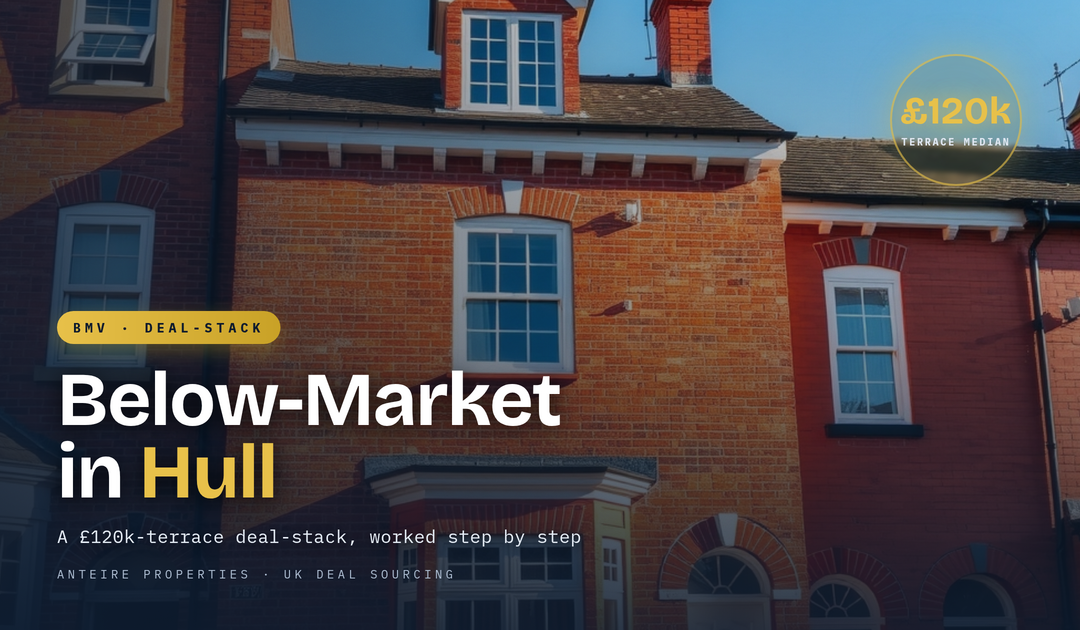
If you want cash-flowing bricks and mortar in 2026, the numbers still point north — and Hull is one of the sharpest examples in England. A city-centre regeneration pipeline, private rents rising faster than the England average, and terraced houses that still change hands for a fraction of a southern deposit. This is a working investor’s guide to buying below market in Hull: what the market actually pays right now, a deal-stack worked line by line, and how our assignment model gets you into these deals without spending your evenings cold-calling agents.
Hull sold prices: computed for this article
| Property type | Sales | Median sold price |
|---|---|---|
| Terraced | 1237 | £120,000 |
| Semi-Detached | 722 | £170,000 |
| Detached | 262 | £275,000 |
| Flat-Maisonette | 108 | £85,000 |
| Other | 71 | £207,500 |
| All types | 2400 | £145,000 |
Method: computed from HM Land Registry Price Paid data, retrieved 2026-08-16: 2400 completed sales in Hull between 2025-10-24 and 2026-06-25. Middle half of the market: £105,000–£190,000. Land Registry records completed sales only, so this dataset cannot support any rent, yield, growth or asking-price figure. Do not state one.
Read that table carefully, because it is built from completed sales, not asking prices. Across all property types in Hull the median completed sale was £145,000, with the middle half of the market between £105,000 and £190,000. The workhorse of any Hull portfolio is the terrace: 1,237 of them changed hands in the window at a £120,000 median. Semis sat at £170,000 and detached homes at £275,000 — but for yield, the terrace is where the maths works, and it is where we concentrate our sourcing.
Why Hull, and why now
Because the demand side is being rebuilt in concrete. The council’s East Bank Urban Village — a 15-year partnership with the English Cities Fund signed at UKREiiF 2025 — is set to deliver up to 850 homes plus commercial and cultural space on the waterfront, and Hull was named one of National Geographic’s Top 25 global destinations to visit in 2026 (Hull City Council). Regeneration and rising visitor numbers tighten the rental market, and private rents across Yorkshire and the Humber have been climbing faster than the England average over the past year (ONS). For a landlord, that combination — low entry price, tightening supply, strengthening rent — is exactly the backdrop you want.
Area averages: computed for this article
| Area | Average price (May 2026) | Average rent pcm (Jun 2026) | Gross yield |
|---|---|---|---|
| Kingston upon Hull, City of | £133,485 | £690 | 6.2% |
| North East Lincolnshire | £148,294 | £623 | 5.0% |
| Doncaster | £172,857 | £690 | 4.8% |
| Bradford | £187,452 | £750 | 4.8% |
retrieved 2026-08-16. Price data: HM Land Registry UK House Price Index (average, May 2026). Rent data: ONS Price Index of Private Rents (average, Jun 2026). Contains HM Land Registry data © Crown copyright and database right 2026. This data is licensed under the Open Government Licence v3.0. Source: Office for National Statistics licensed under the Open Government Licence v3.0. Yields are gross area averages, not valuations or forecasts.
Set the gross yields in that table against the thin returns typical of southern commuter towns, and the case makes itself: in Hull your rent covers more of your borrowing, so your cash works harder and your margin for error is wider. That is the whole reason serious investors buy in the north and let in the north.
The deal-stack, worked step by step
Here is how an experienced investor turns a Hull terrace into a recycled, cash-flowing asset. The figures below are illustrative and rounded to show the mechanics — they are not a specific property or an offer:
- Illustrative worked example — round figures for illustration only, not a specific property or an offer.
- Buy a mid-terrace near Hull’s £120,000 terraced median, negotiated genuinely below market: purchase price about £96,000.
- Light refurbishment to a lettable, refinanceable standard: about £12,000.
- Buying costs — stamp duty, legals, survey: about £4,000.
- Total cash deployed to create the asset: roughly £96,000 + £12,000 + £4,000 = about £112,000.
- Post-works value back around Hull’s £120,000 terraced level; refinance at 75% loan-to-value releases about £90,000.
- Cash left in the deal: about £22,000 — the other £90,000 recycles into your next purchase.
- Let the finished house at the local average shown in the table above, and the rent covers the new mortgage with a gross yield in the high single digits before costs.
Do that twice a year with disciplined numbers and you are building a portfolio on the same pound coin, not a fresh deposit every time. The single biggest risk in that stack is buying at a price that is not actually below market — which is where the discipline has to live.
How the Anteire assignment model gets you in
Most investors never see deals like this because the hard part is the sourcing — the calls, the relationships, the negotiation. Our model hands you the finished deal on an assignable contract, so you step in at the point where the money is made:
- You sign a short NDA, so we can share the full address, the comparables and the numbers behind the deal.
- A fixed reservation fee holds the deal off the market while you complete your own due diligence — no pressure, no auction.
- You receive the full deal pack — purchase price, refurb estimate, comparable evidence, projected rent and our fee — and you speak to the selling agent directly.
- You complete on an assignable contract, typically within a 30-day completion window.
- Our sourcing fee is fixed and disclosed to you up front, built into the deal pack — never a hidden mark-up buried in the purchase price.
That is the difference between hoping a “below-market” deal is real and being handed one with the working shown.
How to check a “below market” price is actually below market
“BMV” is the most abused phrase in property. A genuine below-market deal is 15–25% below market value, and the burden is on the seller to prove it. Here is the checklist we run before we ever call something below market:
- Pull the last-sold prices on the same street from HM Land Registry — the exact public data this article is built on.
- Compare like for like: a two-bed terrace against other two-bed terraces, never against a refurbished three-bed.
- Judge the post-works value against actual completed sales, not the agent’s aspirational asking price.
- Model the deal on the rent the area actually achieves (see the table above), not the top of the range.
- Read the lease, the EPC and any Article 4 or licensing rules before you fall in love with the yield.
Want to see what this looks like in live inventory? Browse what we are currently sourcing on our live deal alerts, or read how it works before you commit a penny.
Work With Anteire Properties
If you want packaged, below-market deals in Hull and across England & Wales — with the comparables, the refurb numbers and the exit already done for you — talk to our team and we will match you to live opportunities that fit your strategy.
📞 Call assistance (24/7): +44 7898 115789
💬 WhatsApp: message us on WhatsApp
🔗 Opportunities for buyers and investors
Sources
- HM Land Registry Price Paid Data — landregistry.data.gov.uk/app/ppd (sold-price medians computed for this article, retrieved 16 August 2026).
- HM Land Registry UK House Price Index & ONS Price Index of Private Rents — ons.gov.uk (area average prices, rents and gross yields).
- Hull City Council regeneration news — news.hull.gov.uk.